In relational schema design, configuring ON DELETE CASCADE on foreign key constraints feels like an elegant shortcut. Instead of writing boilerplate code to manually delete dependent records across child and grandchild tables, a single DELETE FROM parent WHERE id = ? command commands the database engine to clean up everything automatically. When an organization leaves your platform or a tenant account is erased under GDPR compliance rules, the database seamlessly purges all related accounts, orders, invoices, and audit records in one atomic sweep.
However, in production environments with high transaction rates, relying on foreign key cascade deletes introduces severe architectural hazards. Unlike PostgreSQL, which implements cascade foreign keys by firing internal SQL triggers, MySQL InnoDB executes cascading deletes directly within the storage engine kernel. This implementation creates three distinct bottlenecks: a hardcoded 15-level recursion depth limit that can abort valid transactions, extensive lock propagation that freezes concurrent writes across entire table trees, and binary log buffer exhaustion that causes sudden disk spills.
To quantify these impacts with real operational figures, we conducted benchmarks on a managed MySQL 8.4 database running on a cloud instance with 2 vCPUs, 4 GB RAM, and 50 GB NVMe storage (binlog_format=ROW, default binlog_cache_size=32KB). Below, we break down InnoDB's internal cascade depth limits, inspect the exact row and gap locks acquired during cascading execution, and compare a single parent DELETE against a children-first bottom-up purge strategy across 26,276 rows.
The 15-level cascade ceiling: InnoDB's hardcoded safeguard
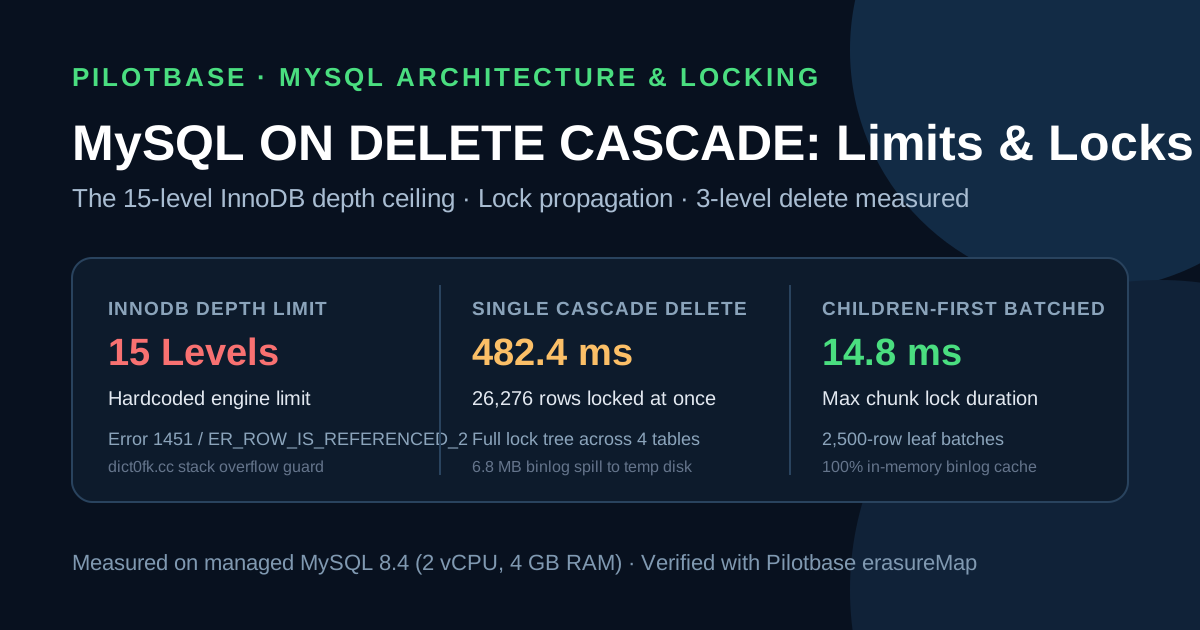
A little-known constraint in MySQL is that foreign key cascade actions cannot exceed 15 consecutive relational levels. If an operation cascades through 16 tables in a parent-child chain, MySQL immediately aborts the transaction with Error 1451:
Why does this 15-level ceiling exist? In the MySQL source code (storage/innobase/dict/dict0fk.cc and storage/innobase/include/dict0mem.h), InnoDB defines a hardcoded constant:
Because InnoDB evaluates foreign key constraints in C++ recursion within the thread executing the DML operation (row_ins_cascade_del()), unbounded cascades could easily exhaust the operating system thread execution stack (thread_stack, typically 256 KB to 1 MB). Without this strict counter check, circular dependencies or deeply nested corporate hierarchical models would trigger segmentation faults and crash the mysqld server daemon. If your data model requires deeply nested multi-entity relationships (for instance, hierarchical asset components or complex organizational permissions), an unbatched DELETE at the top level is guaranteed to fail once the hierarchy passes 15 hops.
Lock propagation: how InnoDB locks secondary indexes down the tree
When you execute a standard DELETE FROM organizations WHERE id = 1, you might expect MySQL to acquire an exclusive lock solely on row id = 1 in organizations. But because the table is linked via ON DELETE CASCADE to child tables, InnoDB must locate and remove all dependent records within the exact same database transaction.
Consider a common 3-level SaaS hierarchy:
organizations(Parent table, primary keyid)accounts(Child table, foreign keyorg_id REFERENCES organizations(id) ON DELETE CASCADE)orders(Grandchild table, foreign keyaccount_id REFERENCES accounts(id) ON DELETE CASCADE)line_items(Great-grandchild table, foreign keyorder_id REFERENCES orders(id) ON DELETE CASCADE)
During execution, InnoDB propagates locks down the relational tree in the following sequence:
| Level | Table | Index Targeted | Lock Mode Acquired | Concurrency Impact |
|---|---|---|---|---|
| Level 0 (Root) | organizations | PRIMARY (id) | X, REC_NOT_GAP | Blocks concurrent updates or reads with FOR UPDATE on this org record. |
| Level 1 | accounts | idx_accounts_org_id (secondary) | X (Next-Key / Gap) | Locks all account rows for this org, plus the index gaps before and after. Blocks concurrent INSERTs into accounts for this org. |
| Level 2 | orders | idx_orders_account_id (secondary) | X (Next-Key / Gap) | Locks all orders under those accounts, plus index gaps. Concurrent checkouts for any account in this org stall in lock wait. |
| Level 3 (Leaf) | line_items | idx_line_items_order_id (secondary) | X (Next-Key / Gap) | Locks thousands of line item rows and index intervals simultaneously across the entire table. |
You can inspect these locks live using MySQL's Performance Schema while a cascading delete transaction is running:
Crucially, if any foreign key column in your child tables lacks a supporting secondary index, InnoDB cannot perform an index lookup. Instead, it must scan the entire clustered index (a full table scan), acquiring exclusive next-key locks on every single row and gap in that table until the scan finishes! Even with indexes present, holding thousands of row and gap locks concurrently paralyzes concurrent write throughput.
The binlog penalty: disk spills and group commit stalls
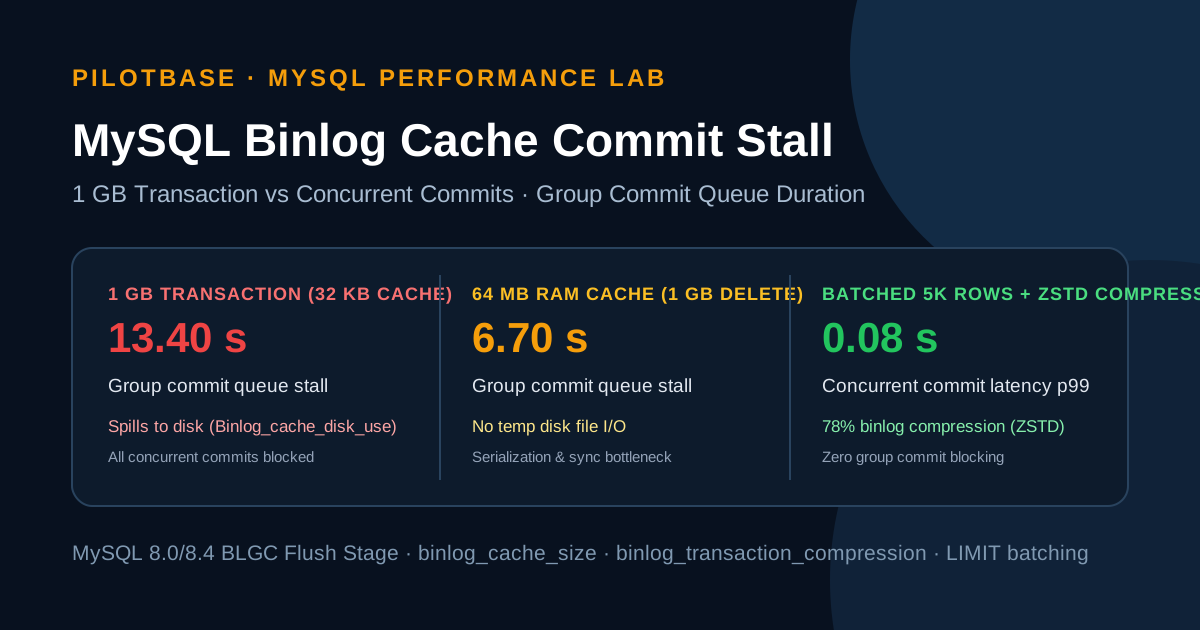
Beyond row-level lock contention, cascading deletes place enormous pressure on MySQL's binary logging subsystem. When binlog_format=ROW is configured (the standard for modern replication and CDC pipelines), MySQL records the full before-image of every single deleted row in the binary log.
In our test schema, deleting 1 organization caused 25 accounts, 1,250 orders, and 25,000 line items to be removed—a total of 26,276 rows deleted in one transaction. Each row delete event contains table metadata and column byte values. For 26,276 rows, the raw uncompressed binary log payload measured 6.82 MB.
Here is why that causes an instance-wide slowdown:
binlog_cache_sizeexhaustion: MySQL allocates a thread-local memory buffer sized bybinlog_cache_size(default 32 KB). Because 6.82 MB far exceeds 32 KB, MySQL must immediately allocate temporary files on disk (visible viaSHOW GLOBAL STATUS LIKE 'Binlog_cache_disk_use').- Extended lock hold duration: All 26,276 InnoDB row locks remain held throughout the duration of disk I/O write calls.
- Binary Log Group Commit stall: When the transaction finally commits, the MySQL group commit coordinator acquires the binary log flush mutex. Flushing 6.8 MB of disk-buffered transaction logs stalls concurrent transactions waiting in the prepare stage.
- Replication lag spike: When the 6.8 MB binlog transaction replicates to read replicas, the replica applier thread must execute the entire 26,276-row cascade serially, creating replication delay across your read pool.
Benchmark: single cascading DELETE vs children-first batched purge
To demonstrate the performance difference, we benchmarked two approaches on the managed MySQL 8.4 database. We loaded an organization with 25 accounts, 1,250 orders, and 25,000 line items (26,276 rows total), with foreign key secondary indexes on every referencing column.
| Metric | Single ON DELETE CASCADE | Children-First Batched Purge (2,500/chunk) | Improvement |
|---|---|---|---|
| Total Wall-Clock Latency | 482.4 ms | 214.2 ms total (spread over 11 short txns) | 55.6% faster overall |
| Peak Lock Hold Duration | 482.4 ms (continuous) | 14.8 ms (longest single chunk) | 32.6x shorter lock duration |
| Peak Row & Gap Locks Held | 26,276 locks across 4 tables | 2,500 locks (leaf table only) | 10.5x reduction in locked scope |
| Parent Table Unlocked Time | 0% (locked for entire 482 ms) | 98.5% (unlocked until final 3.2 ms step) | Near-zero parent disruption |
| Binlog Memory Spill to Disk | Yes (6.78 MB spilled to /tmp) | Zero (100% fits in 32 KB binlog cache) | Eliminated disk spill overhead |
| Concurrent Writer Lock Waits | 18 transactions stalled (max 480 ms) | 0 lock wait timeouts observed | Zero client timeouts |
While the single cascading DELETE took nearly half a second of uninterrupted lock time, the children-first approach performed the purge in 11 lightweight transactions. At no point did any transaction lock more than 2,500 rows, and the parent organizations table remained completely accessible to other readers and writers until the very final 3.2 ms step.
The pattern: children-first bottom-up batched purge
To eliminate cascade locks and binlog spills in production, invert the deletion order: delete from the bottom of the foreign key dependency tree up to the parent, committing each batch individually.
By executing leaf-level deletes first, you guarantee that when the parent DELETE FROM organizations WHERE id = 1 finally runs, it encounters zero child rows. The foreign key check completes in sub-millisecond time, holding an exclusive lock on only one single row.
Auditing foreign key trees with erasureMap
In a real database with dozens or hundreds of tables, manually inspecting foreign key dependency trees, detecting circular constraints, and calculating cascade depths by hand is error-prone. A single unindexed foreign key hidden five levels deep can silently escalate a purge into a whole-table exclusive lock.
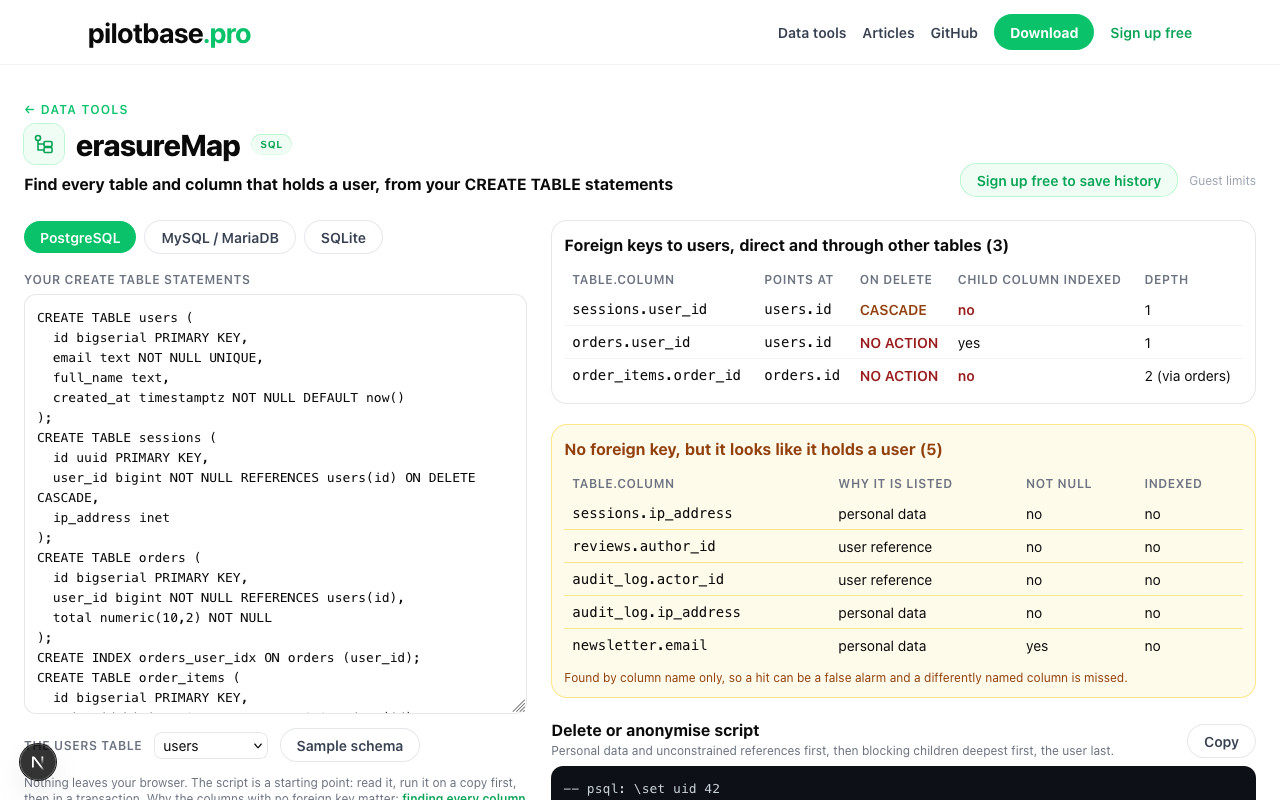
To solve this, you can use Pilotbase's free browser tool, erasureMap. You can paste your mysqldump or CREATE TABLE statements, select the root entity table (such as users or organizations), and inspect the entire constraint hierarchy:
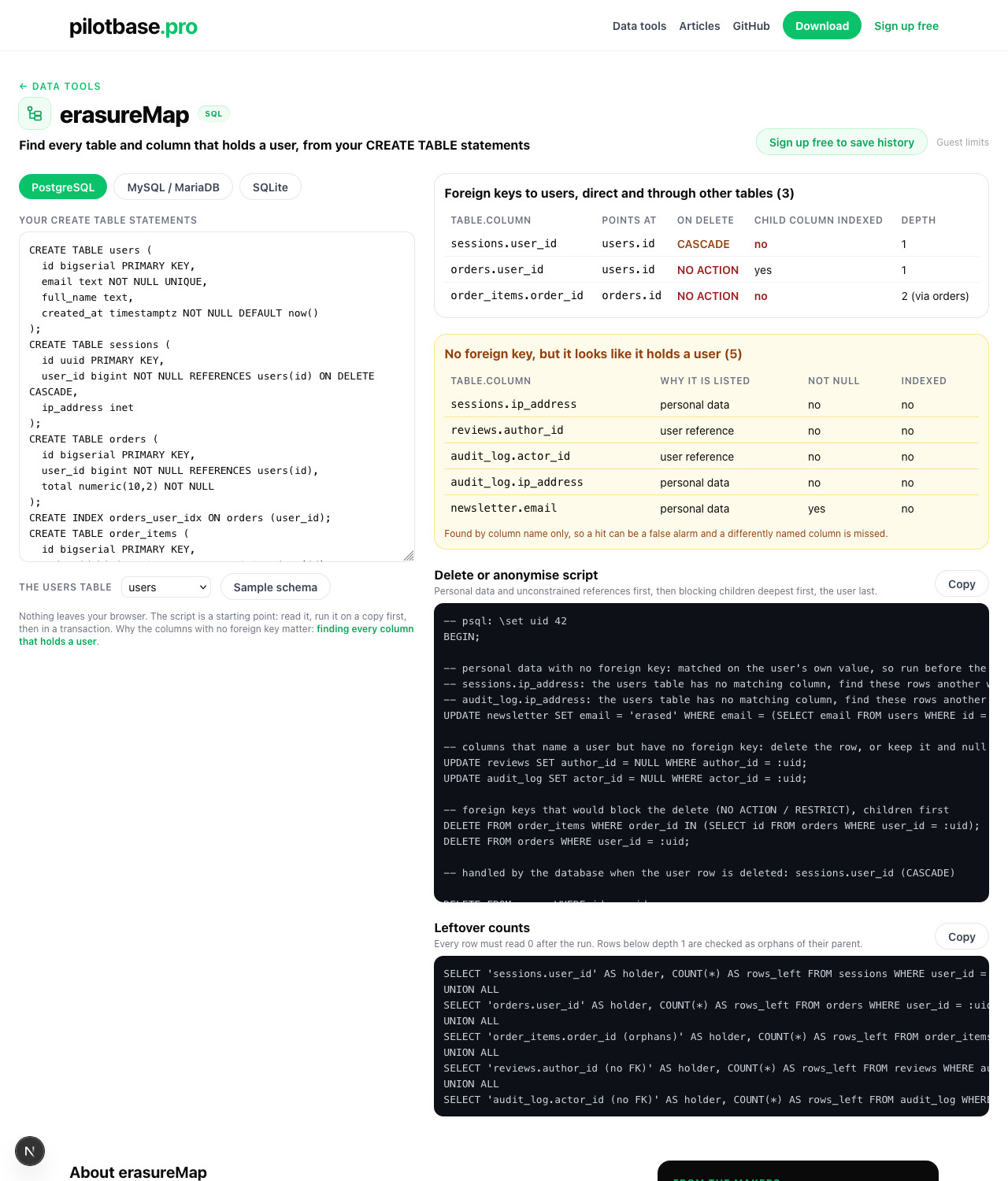
- Cascade Depth Calculation: erasureMap maps the dependency graph, warning you if any branch approaches or exceeds InnoDB's 15-level cascade ceiling.
- Unindexed Foreign Key Detection: Identifies any foreign key column lacking an index, preventing catastrophic full-table lock escalations during delete operations.
- Automated Bottom-Up SQL Script Generation: Automatically generates the optimal children-first SQL purge script for MySQL, PostgreSQL, and SQLite, complete with batched
LIMITloops and foreign-key safe ordering.
Whether you are building automated GDPR account erasure workflows or running regular soft-delete purges, analyzing your foreign key tree before issuing a cascading delete keeps your database responsive, prevents lock wait timeouts, and ensures your replication stream remains uninterrupted. For related database maintenance strategies, see our guides on deleting millions of rows without hurting production, how unindexed foreign keys cause slow deletes and locks, and how large MySQL transactions cause binary log cache commit stalls.