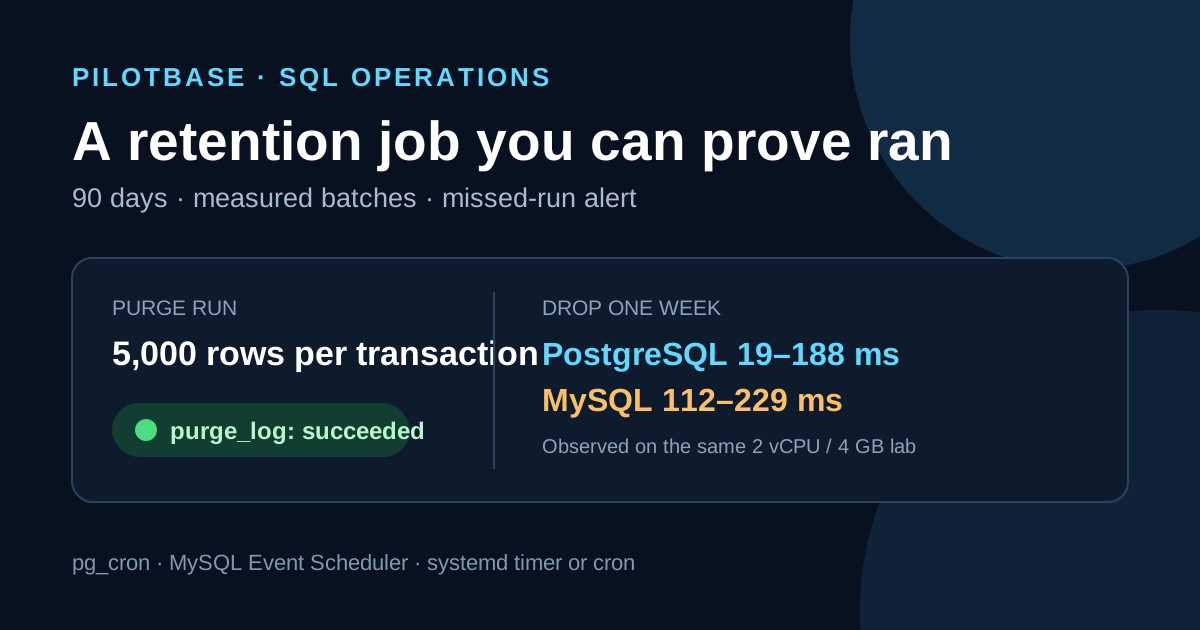
A retention job has two jobs. It must delete rows older than the policy, and it must leave evidence that it finished. event_scheduler = ON, an enabled Event, or a row in cron.job_run_details is not that evidence. In our failure test, MySQL kept the broken Event enabled and advanced LAST_EXECUTED every minute. When either database or scheduler was stopped, neither pg_cron nor MySQL caught up the missed minutes after it returned.
The reliable shape is: delete in measured transactions, write one durable row per run, prevent overlap, and alert when the last successful row is too old. We tested that shape on 6 November 2026 with PostgreSQL 18.6 plus pg_cron 1.6.8 and MySQL Community 8.4.13. Each database held 4,000,000 made-up log rows on the same 2 vCPU, 4 GB machine.
The result first: start at 5,000, then measure your database
Those numbers are not a sizing table for another server. They show the trade-off to measure. Larger batches finished the whole purge sooner, but made one transaction and its locks last longer. On MySQL, a concurrent update to an old row waited as long as 2.2 seconds in the 100,000-row test. PostgreSQL wrote about 30 MB of WAL per 100,000 deleted rows at every batch size; MySQL wrote about 19 MB of row-based binlog plus 16–33 MB of redo. Small commits did not make replication traffic disappear.
Use 5,000 as a cautious first measurement, not a rule. Record each batch's rows and elapsed time. Reduce it if a batch regularly exceeds your writer-latency budget; increase it if statements are short and commit overhead dominates. Test while the real writers and replicas are busy. Our test had three rounds on one small host, with clients sharing its CPUs, and did not include replicas.
The proof table
Insert running before the first delete. After every committed batch, update rows_deleted and batches in its own transaction. On success, set status = 'succeeded' and finished_at. In an exception handler set failed, the error text and finished_at, then re-raise the error so an outside scheduler also sees a non-zero exit. In our injected failures, five committed batches—25,000 rows—stayed deleted and the log correctly said failed, rows_deleted = 25000, batches = 5. A retry simply continued from the cutoff.
PostgreSQL procedure and pg_cron
A procedure that commits must be the only statement in pg_cron's command: CALL ...; SELECT 1 failed in our test. pg_cron does not overlap two instances of the same job; a due run waits for the current one. Check cron.job_run_details, but treat it as scheduler diagnostics, not business proof. It is never cleaned automatically, so schedule a second job to delete old rows from it. We also found that changing cron.host fixed new jobs but an existing job kept its stored connection setting and had to be recreated.
MySQL procedure and Event
MySQL Events can overlap: our 90-second Event started another copy each minute. With GET_LOCK(name, 0), the second invocation logged a skip and left. MySQL 8.4 had event_scheduler = ON by default, but it can be OFF or startup-only DISABLED, and super_read_only stops it. A failed Event stayed ENABLED; its error existed only in the server error log. That is why the proof query below reads purge_log, never LAST_EXECUTED. Release the named lock in both the normal and exception paths.
Outside scheduling: the most observable option
Use an outside scheduler when the database service does not offer pg_cron/Events, when operations already watches systemd or Kubernetes Jobs, or when you want credential rotation and failure alerts outside the database. In our systemd test, Persistent=true caused one catch-up immediately after a three-minute outage—not one run for every missed minute—and flock -n prevented overlap. The database procedure and purge_log stay the same, so changing schedulers does not change the safety model. A plain cron line works too, but add a lock and alert on its exit code.
Alert on a missing success, not merely on a failure
A failure alert alone misses a scheduler that never started. Run this query from a different scheduler or monitoring system, after the expected finish time plus a realistic grace period. Our two-minute lab check was healthy after a successful run and raised no good purge in 2 minutes after the schedule was removed. Also alert on running rows older than your maximum expected duration, and keep failed/skipped rows long enough to explain gaps.
For large append-only tables, rotate partitions
Partition rotation avoids touching every expired row and releases that partition's storage. It is not lock-free. A long PostgreSQL reader made DROP TABLE wait 13 seconds and stalled inserts for 13 seconds; lock_timeout = '2s' cancelled it after two. DETACH PARTITION ... CONCURRENTLY also waited for the reader, but inserts kept moving (339 ms worst in this small test). It must run outside a transaction block and cannot be used with a default partition. MySQL DROP PARTITION waited 14 seconds for a metadata lock and blocked inserts behind it; lock_wait_timeout = 2 bounded that wait. MySQL has no equivalent concurrent detach.
Create future partitions before they are needed. Splitting an empty MySQL pmax during our rotation took 3.2 seconds, while creating the next PostgreSQL partition took 14 ms. Retry a timed-out rotation later and alert from the same run log. Do not fall back to an unbounded wait in the busiest hour.
The production checklist
Deleting rows does not necessarily shrink the file. PostgreSQL's heap and indexes stayed 845 MB and 292 MB after deleting roughly half the table and running ordinary VACUUM; the space became reusable. MySQL's .ibd stayed about 1,145 MB until OPTIMIZE TABLE rebuilt it in 14.1 seconds and reduced it to 642 MB. Do not add a weekly rebuild by reflex: it is a separate, locking maintenance decision.
Open the purge_log beside the table, save the proof and skipped-run queries, and inspect each batch while you tune it. Pilotbase is free for Windows, macOS and Linux, or Docker on a server.
Get PilotbaseBefore adding the procedure, Event or partition DDL, paste it into sqlInspector for PostgreSQL or MySQL migration and lock warnings.
Open sqlInspectorRelated: Deleting millions of rows without hurting production explains the delete mechanics in more depth; A daily database health table records size, dead rows and key runway around this job.
Primary sources: the pg_cron README for scheduling, connection settings, one-instance behaviour and cron.job_run_details; PostgreSQL 18 declarative partitioning and ALTER TABLE for detach locks and restrictions; MySQL 8.4 CREATE EVENT, Event Scheduler configuration, and partition maintenance. Measurements are ours; exact versions, schema, raw results and limitations were recorded with the test on 6 November 2026.